IPv6 Migration: Why ISPs Can’t Afford to Wait
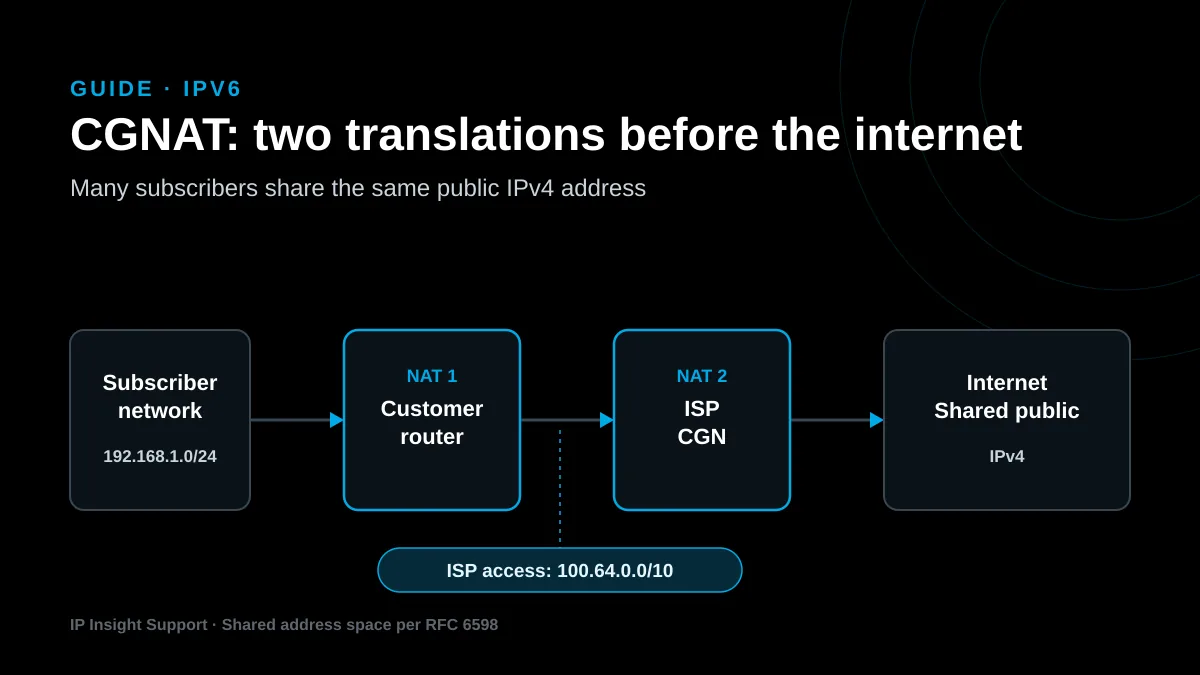
Why should an ISP migrate to IPv6? Because there are no free IPv4 addresses left to grow, and every new IPv4 customer depends on buying addresses or on CGNAT. IPv6 provides plenty of addresses, reduces CGNAT load and prepares the network for customers who already ask for it.
In short
| Topic | In a few words |
|---|---|
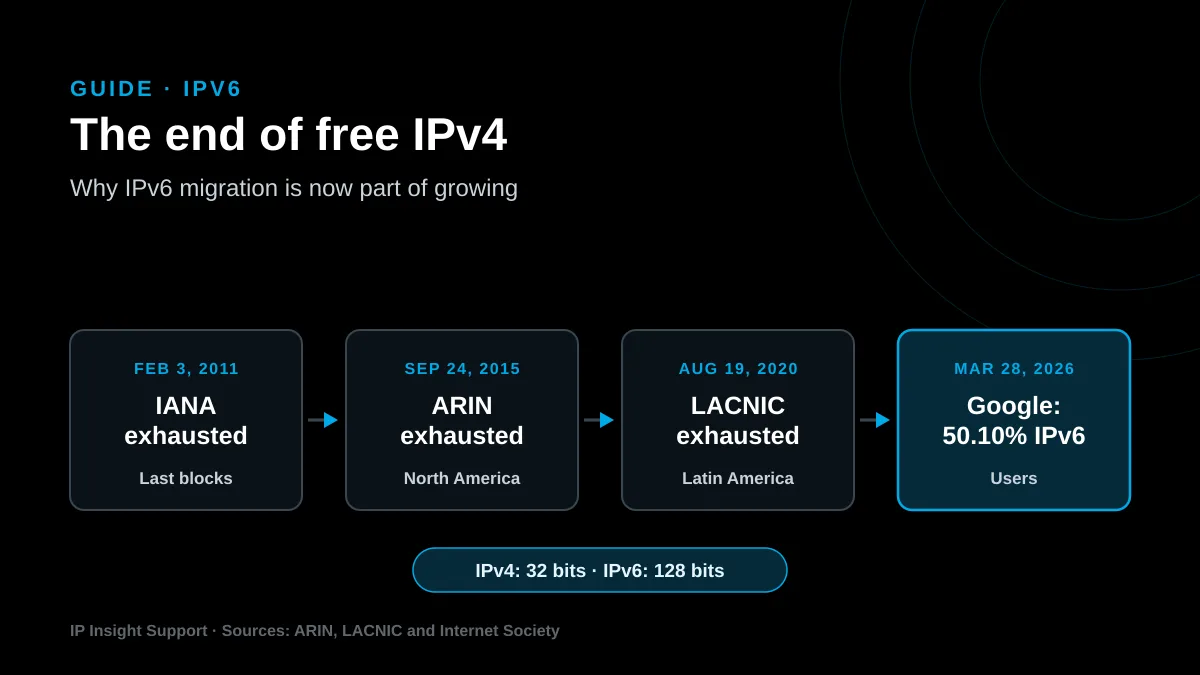
| Problem | Free IPv4 exhausted at ARIN (2015) and LACNIC (2020). |
| Cost of waiting | Buying IPv4 or expanding CGNAT. |
| Size | IPv4 uses 32 bits; IPv6, 128 bits. |
| Adoption | 50.10% of Google users on IPv6 on March 28, 2026. |
| Regulation | In Colombia, MinTIC set deadlines for public entities. |
| Next step | Addressing plan and dual stack. |
Why isn’t IPv4 enough to grow anymore?
IPv4 uses 32-bit addresses, roughly 4.3 billion in total. That space has already been handed out: IANA delivered its last blocks in 2011, ARIN exhausted its pool on September 24, 2015 and LACNIC on August 19, 2020.
Since then, an ISP that needs IPv4 has three options: the waiting list, buying on the transfer market or sharing addresses with CGNAT. All three cost money or operations effort.
What does an ISP gain with IPv6?
- Plenty of addresses: IPv6 uses 128 bits, so every customer can get its own prefix.
- Less CGNAT: traffic to IPv6 services doesn’t go through the translator or use ports.
- Fewer logs: fewer translations mean less data to keep per subscriber.
- Inbound connections: cameras, servers and VPNs become reachable again without workarounds.
- A ready network: prepared for business customers and projects that already require IPv6.
How much internet traffic already uses IPv6?
According to Google’s measurement, on March 28, 2026, 50.10% of users reached its services over native IPv6, the first time it passed the halfway mark, as reported by Internet Society Pulse. The figure changes daily and varies widely between countries and operators.
For an ISP, this means a large share of its customers’ traffic could leave over IPv6 as soon as the network offers it.
What does regulation require in Colombia?
In Colombia, MinTIC set guidelines for adopting IPv6 with Resolution 2710 of 2017, amended by Resolution 1126 of 2021. According to MinTIC, the deadline for national entities expired on June 30, 2022, and the deadline for territorial entities was December 31, 2022.
These entities must operate in dual stack, and the same resolution expects network and service providers to offer them IPv6 connectivity. For a Colombian ISP, offering IPv6 is also a way to serve the public sector.
How do you migrate to IPv6 without affecting customers?
- Inventory of equipment, CPE and systems with IPv6 support.
- Addressing plan with prefixes per site and per customer.
- IPv6 in the core and edge, with prefixes announced over BGP.
- A pilot group of customers in dual stack.
- IPv6-specific security policies and monitoring.
- Gradual rollout to the whole customer base.
Each step is explained in our IPv6 transition guide.
How do we handle it at IP Insight Support?
Our team has 10+ years of experience with carrier networks. We plan the IPv6 migration together with the CGNAT you already run, so both pieces work together during the transition. Learn about our IPv6 implementation service.
IPv6 migration frequently asked questions
Does migrating to IPv6 mean turning off IPv4?
No. During the transition you use dual stack: IPv4 and IPv6 run side by side. IPv4 stays as long as there are services that only work over that protocol.
Can I keep growing with CGNAT alone?
For a while, yes, but every new customer adds load, ports and logs to the CGNAT. IPv6 reduces that load because its traffic doesn’t go through the translator.
Is it hard to get an IPv6 block?
No. Unlike IPv4, IPv6 has no exhaustion waiting list. You request it from your regional registry, such as ARIN or LACNIC, under its policies and fees.
Will my customers notice the migration?
If it’s done well, no. Modern devices prefer IPv6 when it’s available and fall back to IPv4 if a service fails, using mechanisms such as Happy Eyeballs (RFC 8305).
What if my CPE don’t support IPv6?
You can start with customers whose equipment supports it and replace the rest in stages. The initial inventory shows how many devices fall into each group.
Does Colombian regulation apply to ISPs?
MinTIC’s resolutions bind public entities and expect providers to offer them IPv6 connectivity. For obligations specific to your company, review the current rules with your legal advisor.
Is your network ready for IPv6? Talk to an engineer and let’s review your case.
More guides for network operators
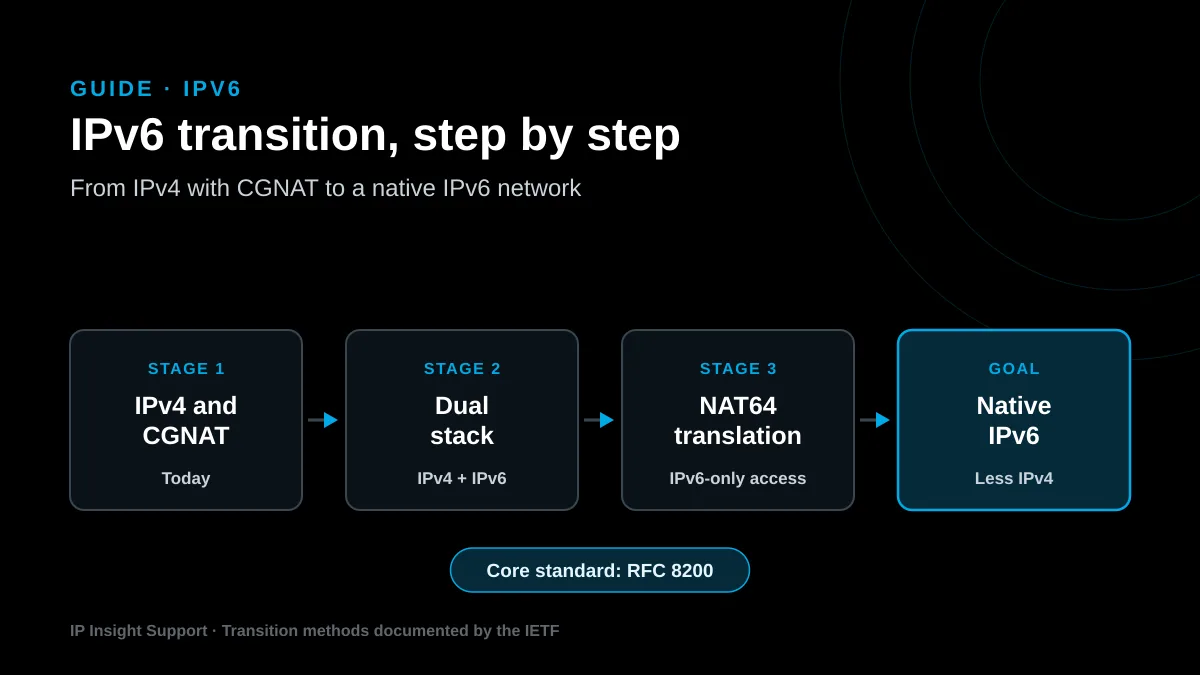
IPv6 Transition: A Guide for ISPs and Businesses
Read the guide