


BGP configuration that is stable and secure
We handle BGP configuration at your edge so your network has redundancy across transit providers, controls where traffic enters and leaves, and announces your prefixes securely.
10+ years of experience Multi-vendor compatibility Multihoming Filters and RPKI
Where this service fits in the life of your network
Each service hands a documented network to the next one, so you can start at the stage your network needs today.
- Know what you haveNetwork audit and documentationExplore
- Build what you needNetwork design and implementationExplore
- Make it performNetwork engineering and architectureExplore
- Move it forwardNetwork migration and IPv6Explore
Run an RV park, campground or hotel? NETXIOM applies the same lifecycle to managed guest WiFi.
BGP that protects your network and reputation
We design and configure your BGP sessions with transit providers, IXPs and customers. We apply inbound and outbound filters and policies that let you decide where your traffic flows.
We work on edges built with equipment from many vendors, and align your BGP policy with what your transit providers and IXPs require. Every policy is documented so your team understands and maintains it.
- eBGP sessions with transit providers and IXPs
- Multihoming with two or more providers
- Prefix filters and RPKI origin validation
- Inbound and outbound traffic engineering
- iBGP and route reflectors in the core
- BGP communities for blackholing and route control
From a fragile edge to a controlled edge
BGP changes planned so you don’t lose connectivity.
Assess
We review your sessions, prefixes, registry objects and the current edge configuration.
Design
We define inbound and outbound policies, filters and how each provider is used.
Configure
We apply changes in maintenance windows, with a rollback plan.
Validate
We verify announcements, received routes and failover when a provider goes down.
What a well-configured BGP gives you
Real redundancy
If one provider fails, traffic keeps flowing through the other.
Controlled transit costs
Decide which traffic uses each exit.
Lower risk of leaks
Filters keep you from announcing routes that aren’t yours.
Better reputation
Your prefixes are signed and validated with RPKI.
BGP configured with an operator’s judgment
A BGP mistake can affect your network and other people’s networks. Our engineers apply the practices transit providers and IXPs require, and document every policy so your team understands it.
In BGP, whatever you don’t filter ends up announced.
Where your network can go from here
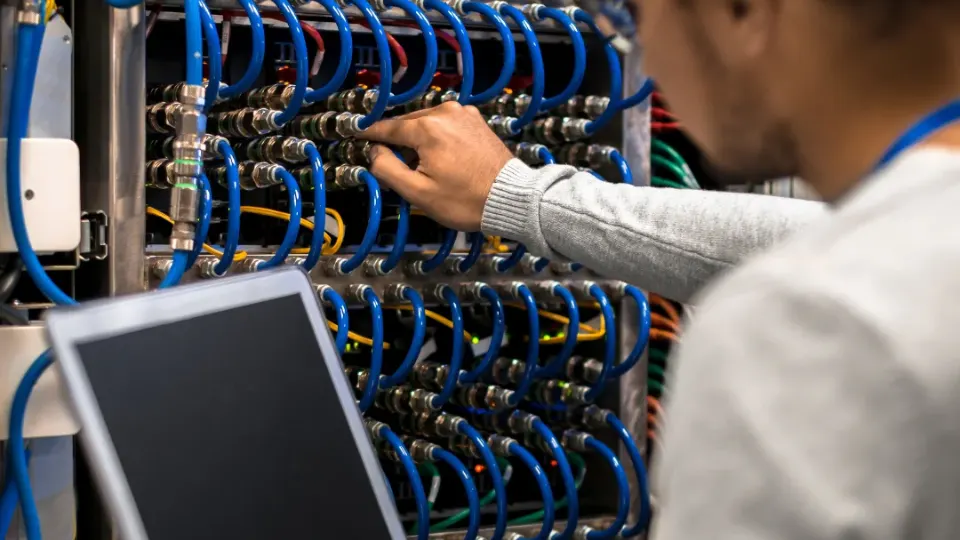
Network engineering and architecture
Configuration, optimization and troubleshooting across vendors, validated before it goes live.
Explore network engineering and architecture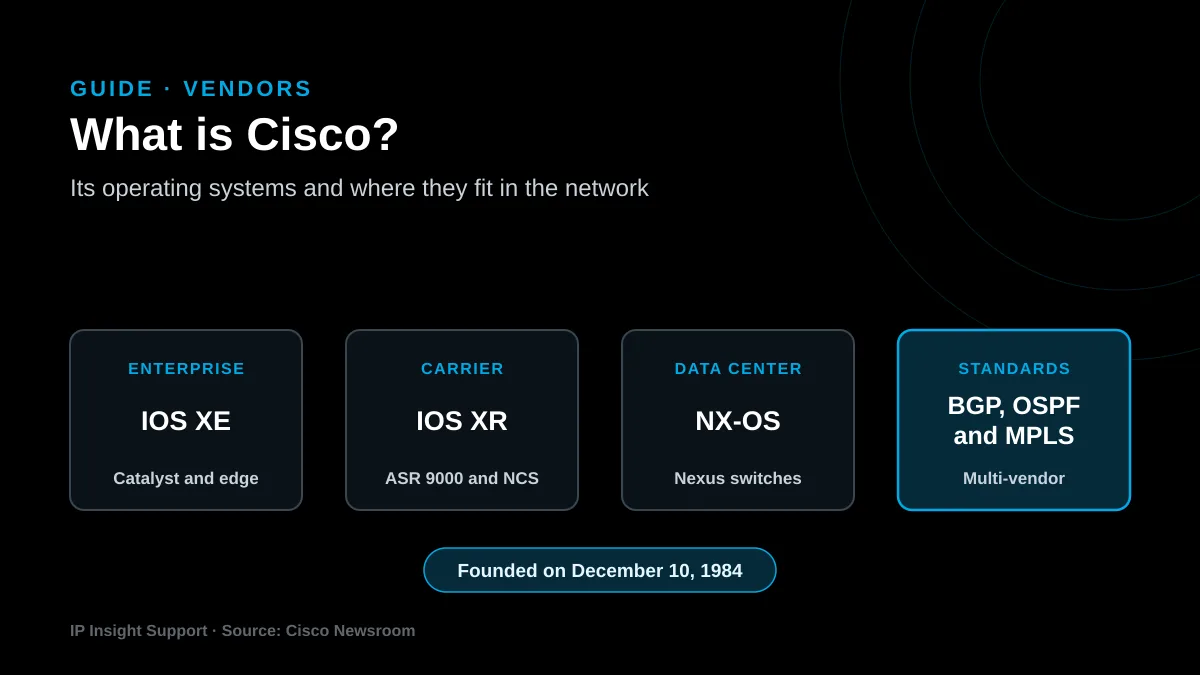
What Is Cisco? Platforms and Equipment for ISPs
What Cisco equipment is and what it offers internet service providers: reliability, scalability and security, and when it makes sense for your network.
Read the guide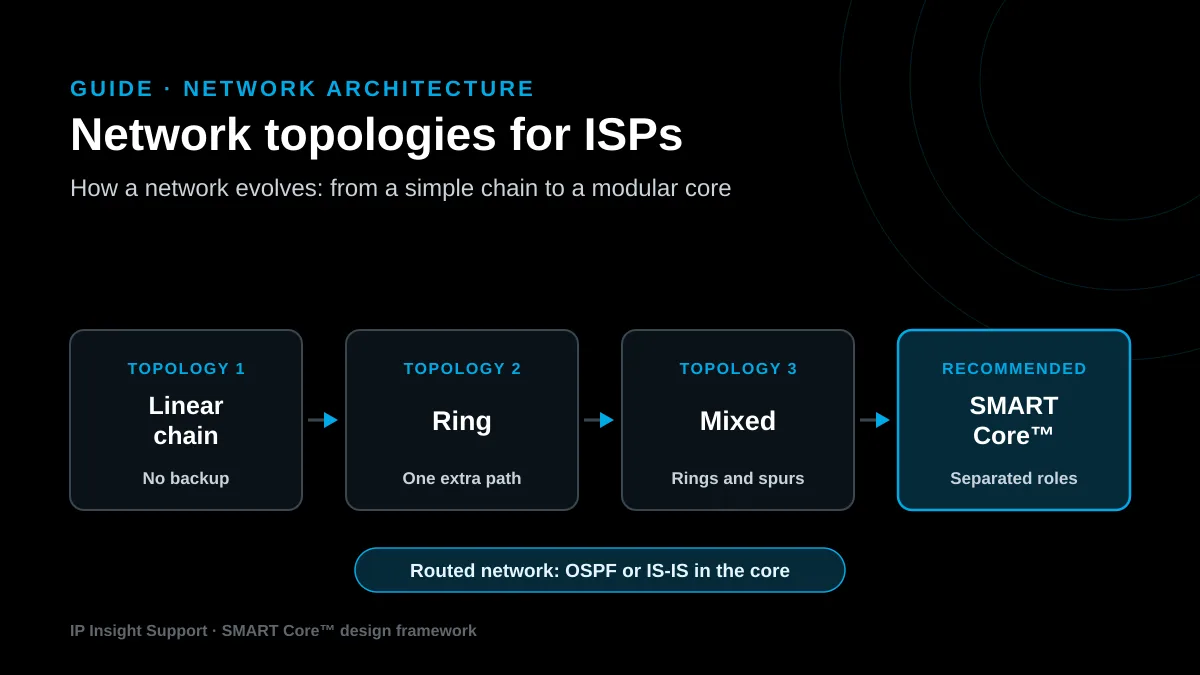
Network Topologies for ISPs: Backbone, Ring and Mixed
How the most common ISP and WISP topologies compare, and how to move past their limits.
Read the guideFrequently asked questions
Do you have another question? Write to us and an engineer will answer, in English or Spanish.
What is BGP and why does an ISP need it?
BGP (Border Gateway Protocol) is the protocol internet networks use to exchange routes, defined in RFC 4271. An ISP needs it to connect to more than one transit provider, announce its own addresses and decide where its traffic leaves.
What do I need to run BGP?
Usually an autonomous system number (ASN) and your own address block, assigned by your regional registry such as ARIN or LACNIC, plus transit providers that accept a BGP session.
What is RPKI and should I use it?
RPKI lets you sign which autonomous system may announce each prefix, and validate the routes you receive. We recommend it because it reduces the risk of prefix hijacks and route leaks.
Can you balance traffic between two providers?
Yes. We use local preference, prepending, communities and more-specific announcements to split inbound and outbound traffic according to your cost and quality goals.
Do you configure BGP on MikroTik, Juniper and Cisco?
Yes. We work with MikroTik, Juniper, Cisco, Arista and other vendors, including networks where several of them coexist.
Can you help connect to an IXP?
Yes. We configure sessions with the exchange’s route servers and with direct peers, using the filters the IXP requires.
Ready to control your edge with BGP?
Let’s talk about your providers and prefixes, and define a stable, secure BGP policy.