


MPLS configuration for carrier services
We handle MPLS configuration in your core to offer layer 2 and layer 3 VPNs, separate services and steer traffic with more control, on the network you already have.
10+ years of experience Multi-vendor compatibility L2 and L3 VPNs Service separation
Where this service fits in the life of your network
Each service hands a documented network to the next one, so you can start at the stage your network needs today.
- Know what you haveNetwork audit and documentationExplore
- Build what you needNetwork design and implementationExplore
- Make it performNetwork engineering and architectureExplore
- Move it forwardNetwork migration and IPv6Explore
Run an RV park, campground or hotel? NETXIOM applies the same lifecycle to managed guest WiFi.
A core that carries services, not just packets
With MPLS, your core can carry separate services for each customer or traffic type. We configure layer 2 and layer 3 VPNs, and the foundation to grow into business services.
We work on single-vendor cores and mixed networks, and design services so your team can create and operate them without depending on us. Every service is documented end to end.
- MPLS core design over OSPF or IS-IS
- Label distribution with LDP
- Layer 2 VPNs (VPLS and pseudowires)
- Layer 3 VPNs (L3VPN with VRF)
- Traffic separation per service or per customer
- Documentation and operating procedures
From an IP network to a services core
A process that introduces MPLS without disrupting routing.
Assess
We review your core, your interior routing protocol and your equipment’s capacity.
Design
We define where MPLS runs, which services it carries and how they’re named and documented.
Configure
We enable MPLS in stages and build the first services in a controlled environment.
Validate
We test services end to end and their behavior during link failures.
What MPLS gives you
New services
Offer private links and VPNs to business customers.
Separate services
Each customer or service travels in its own space.
More traffic control
Decide which path each service takes.
A reusable core
The same network carries internet, VPNs and management.
MPLS designed for your scale
MPLS isn’t only for large carriers. Our engineers size it to your network, with the services your business actually sells, and document it so your team operates it with confidence.
A good MPLS core shows in the services it lets you sell.
Where your network can go from here

Network engineering and architecture
Configuration, optimization and troubleshooting across vendors, validated before it goes live.
Explore network engineering and architecture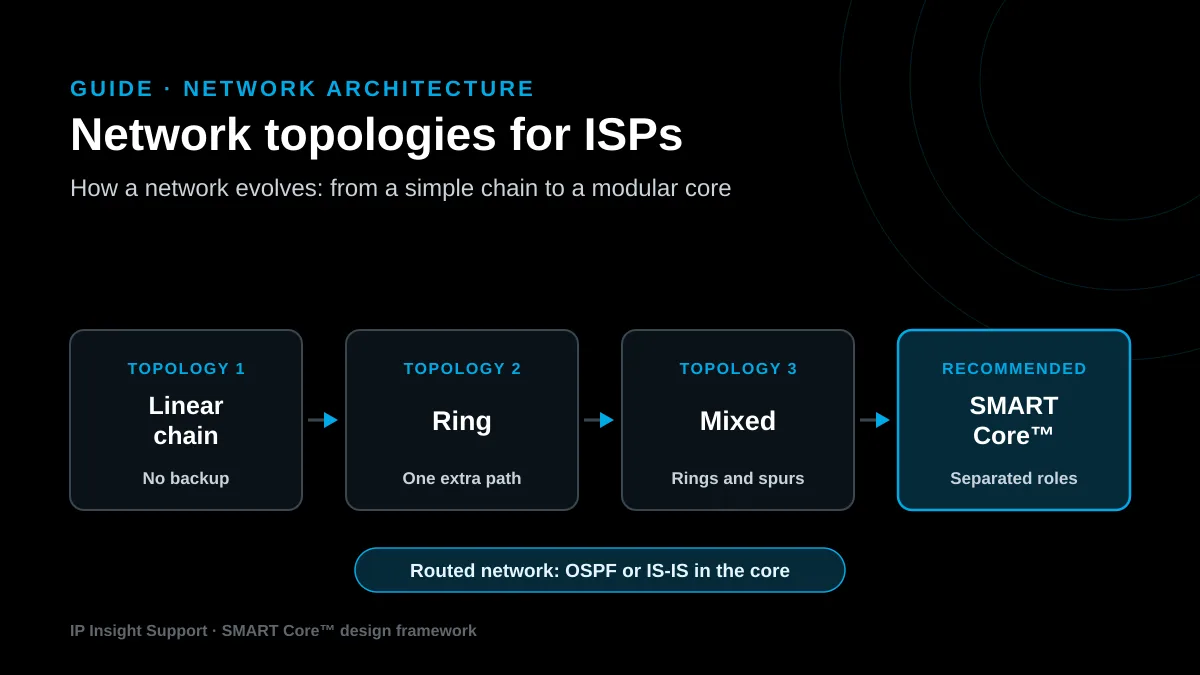
Network Topologies for ISPs: Backbone, Ring and Mixed
How the most common ISP and WISP topologies compare, and how to move past their limits.
Read the guide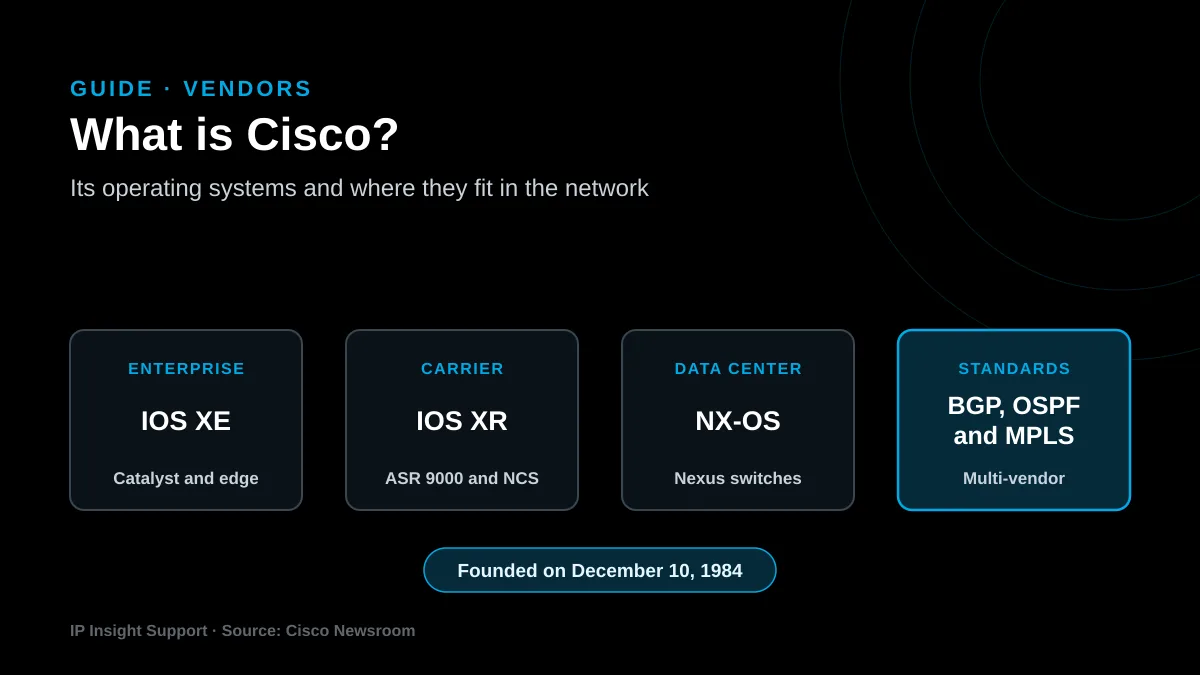
What Is Cisco? Platforms and Equipment for ISPs
What Cisco equipment is and what it offers internet service providers: reliability, scalability and security, and when it makes sense for your network.
Read the guideFrequently asked questions
Do you have another question? Write to us and an engineer will answer, in English or Spanish.
What is MPLS?
MPLS (Multiprotocol Label Switching) forwards traffic using labels instead of looking up the IP address at every hop. Its architecture is defined in RFC 3031, and it lets you build VPNs and separate services over one core.
Does my ISP need MPLS?
You need it if you want to sell private links or VPNs to businesses, separate services in the core or control the path traffic takes. If your network is small and only sells internet, maybe not yet. We’ll tell you honestly after assessing your network.
What’s the difference between VPLS and L3VPN?
VPLS connects the customer’s sites as if they were on the same switch, at layer 2. L3VPN gives the customer a private routed network, at layer 3, with its own routing table.
Can I use MPLS with MikroTik equipment?
Yes. MikroTik supports MPLS with LDP, VPLS and VRF, and we configure it on MikroTik networks and on networks with other vendors such as Juniper and Cisco.
Do I need OSPF before MPLS?
MPLS needs a stable interior routing protocol such as OSPF or IS-IS. If your network is still bridged, we recommend migrating to a routed network first.
Does MPLS affect my subscribers’ internet traffic?
Implemented well, no. We introduce it in stages and validate that existing traffic keeps working before creating new services.
Ready to turn your core into a services network?
Let’s talk about the services you want to offer and define an MPLS design sized for you.