


DNS and RADIUS servers for ISPs
We deploy DNS and RADIUS servers that authenticate your subscribers and resolve their queries, with redundancy, so one failed server doesn’t leave your customers offline.
10+ years of experience Multi-vendor compatibility AAA authentication Recursive and authoritative DNS
Where this service fits in the life of your network
Each service hands a documented network to the next one, so you can start at the stage your network needs today.
- Know what you haveNetwork audit and documentationExplore
- Build what you needNetwork design and implementationExplore
- Make it performNetwork engineering and architectureExplore
- Move it forwardNetwork migration and IPv6Explore
Run an RV park, campground or hotel? NETXIOM applies the same lifecycle to managed guest WiFi.
The services your network uses on every connection
Every subscriber who connects goes through RADIUS to authenticate and DNS to browse. We deploy both services with redundancy and monitoring, integrated with your routers and your management system.
We integrate the servers with routers and management systems from many vendors, and leave procedures for activations, cancellations and plan changes. That way your daily operation doesn’t depend on a single person.
- RADIUS servers for authentication, authorization and accounting
- Integration with BNG, edge routers and HotSpot
- Recursive DNS for subscribers
- Authoritative DNS for your domains and reverse zones
- High availability with redundant servers
- Monitoring and authentication logs
From design to servers in production
A process that avoids outages when changing critical services.
Assess
We review how you authenticate subscribers today and which DNS servers they use.
Design
We define the architecture, redundancy and integration with your equipment and management system.
Deploy
We install and configure the servers, and migrate users in groups.
Validate
We test authentication, accounting and DNS resolution, and hand over documentation.
What well-deployed critical services give you
Fewer support calls
When DNS answers fast, customers feel a faster service.
Per-subscriber control
Plans, speeds and account status applied from one place.
No single point of failure
Redundant servers so one failure doesn’t stop connections.
Logs on hand
Session history for support and for legal requests.
Critical services with an operator’s view
We integrate RADIUS and DNS with the rest of your network: BNG, quality of service, CGNAT and monitoring. Each service works as part of a system, not as an isolated server.
When DNS fails, your customer thinks the internet failed.
Where your network can go from here

Network engineering and architecture
Configuration, optimization and troubleshooting across vendors, validated before it goes live.
Explore network engineering and architecture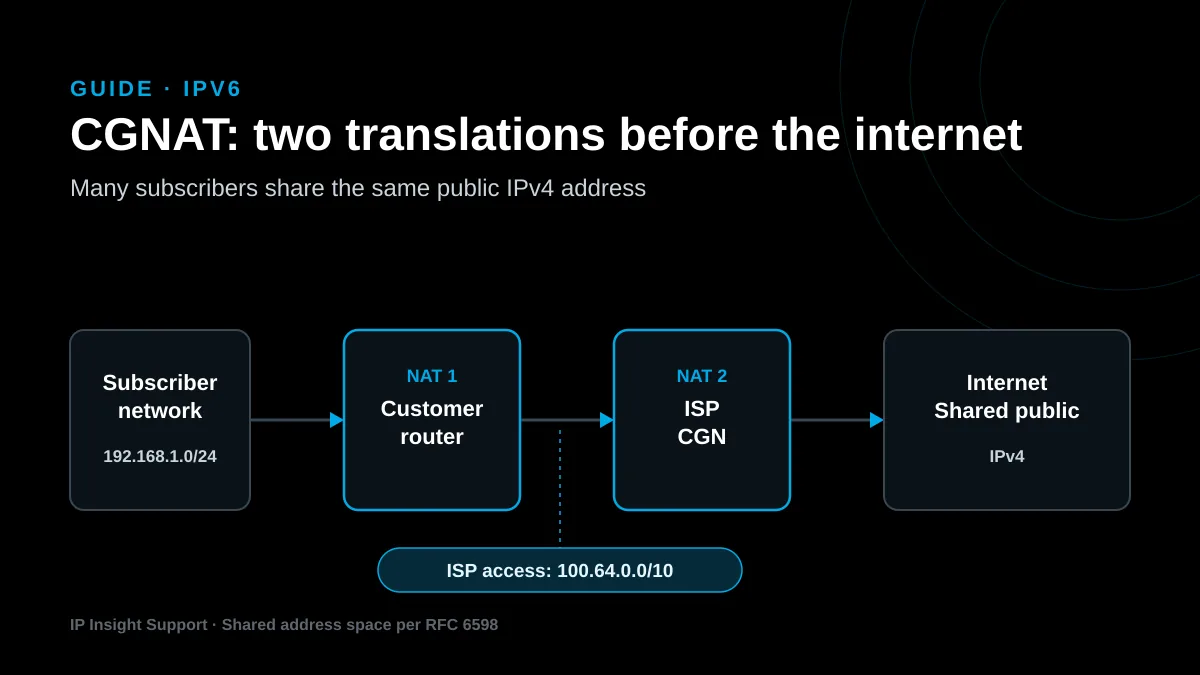
What Is CGNAT and When Does an ISP Need It?
What CGNAT is, how the 100.64.0.0/10 range works, when an ISP without new IPv4 needs it and why IPv6 is the long-term answer.
Read the guide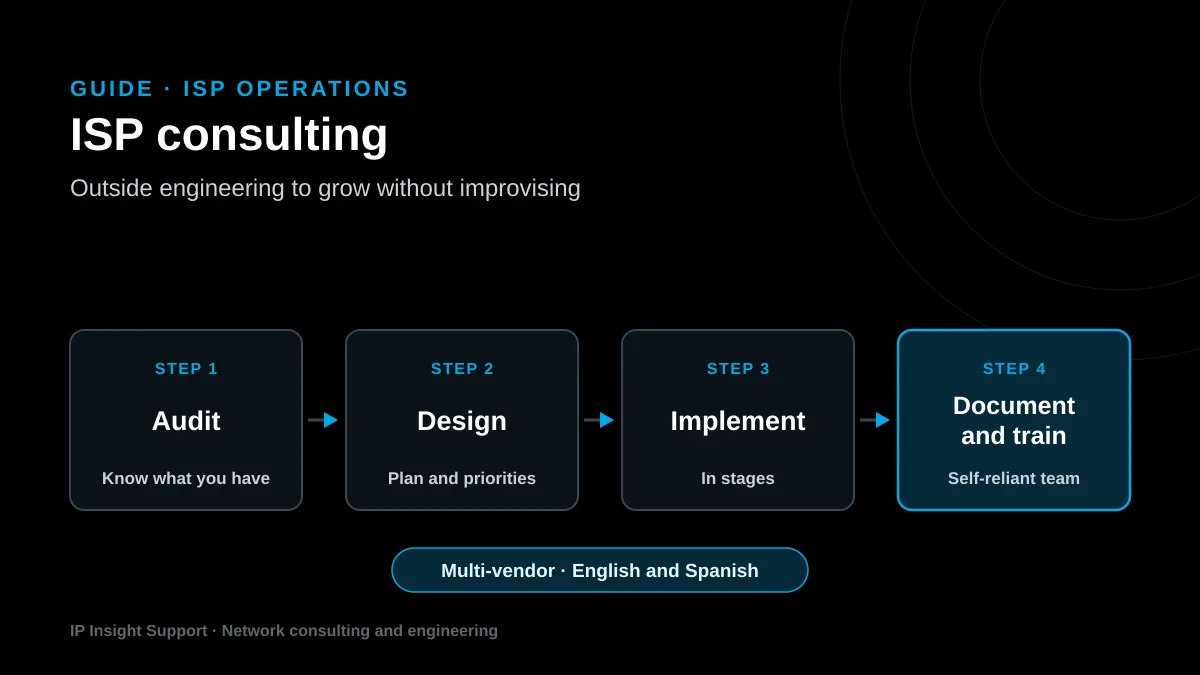
ISP Consulting: What It Is and When You Need It
Why ISPs work with network consultants: assessment, custom design, security and scalability, and what to expect from an independent engineering partner.
Read the guideFrequently asked questions
Do you have another question? Write to us and an engineer will answer, in English or Spanish.
What is a RADIUS server at an ISP?
It’s the server that checks who connects to your network, assigns their plan and logs session usage. RADIUS stands for Remote Authentication Dial-In User Service, defined in RFC 2865.
Why should an ISP run its own recursive DNS?
A well-placed recursive DNS of your own answers subscribers faster and reduces outbound traffic. It also gives you control and visibility over a service every customer uses.
Can you integrate RADIUS with my customer management system?
Yes. We integrate RADIUS with management and billing systems that support it, so activations, cancellations and plan changes apply without manual steps.
How do you keep a failure from taking customers offline?
We deploy at least two servers per service, on different hosts or locations, and configure routers to fail over to the backup automatically.
Are the logs useful for law enforcement requests?
RADIUS session logs, together with CGNAT logs when applicable, make it possible to identify which subscriber used an address at a given time. We help you define how long to keep them under your country’s rules.
Do you work with MikroTik routers?
Yes. We integrate RADIUS with MikroTik and other vendors for PPPoE, HotSpot, DHCP and administrator access.
Ready for reliable critical services?
Let’s talk about how you authenticate subscribers today and define an architecture with redundancy.