


Bridge to OSPF migration without taking your network down
We handle your bridge to OSPF migration: your network moves from one large bridged domain to a routed network, so a loop or broadcast storm stops taking every tower down at once.
10+ years of experience Multi-vendor compatibility Routed network Staged migration
Where this service fits in the life of your network
Each service hands a documented network to the next one, so you can start at the stage your network needs today.
- Know what you haveNetwork audit and documentationExplore
- Build what you needNetwork design and implementationExplore
- Make it performNetwork engineering and architectureExplore
- Move it forwardNetwork migration and IPv6Explore
Run an RV park, campground or hotel? NETXIOM applies the same lifecycle to managed guest WiFi.
A network that stops failing in cascade
A bridged network shares a single broadcast domain, so a problem at one tower is felt at all of them. We migrate to OSPF with a per-site addressing plan, so every tower is its own segment and the network uses redundant paths.
We work with the equipment already on your towers and plan every stage so subscribers don’t notice the change. When we finish, your network is documented, with an addressing plan any engineer can follow.
- Diagnosis of the current bridged network
- IP addressing plan per tower and link
- OSPF area design and link costs
- Staged migration in planned windows
- Redundant routes and failover convergence
- Documentation of the routed network
From bridge to a routed network
A method designed to keep subscribers online.
Assess
We map the topology, VLANs and services that depend on the bridge.
Plan
We design addressing, OSPF areas and the migration order for each site.
Migrate
We move the network tower by tower in agreed windows, with a rollback plan.
Validate
We test routes, redundancy and services at each site before moving to the next.
What a routed network gives you
Isolated failures
A loop at one tower no longer affects the rest of the network.
Automatic redundancy
OSPF finds another path when a link goes down.
Simpler troubleshooting
Each site has its own segment and is easy to trace.
A base to grow
Ready for MPLS, IPv6 and new services.
Experience migrating ISP and WISP networks
Many wireless networks grew bridged because it was the fastest way. Our engineers know that reality and plan the migration so your operation keeps running while the network changes underneath.
A bridged network works fine, until the day it stops working everywhere.
Where your network can go from here

Network migration and IPv6
IPv6, topology changes and new network solutions, executed with minimal risk and downtime.
Explore network migration and IPv6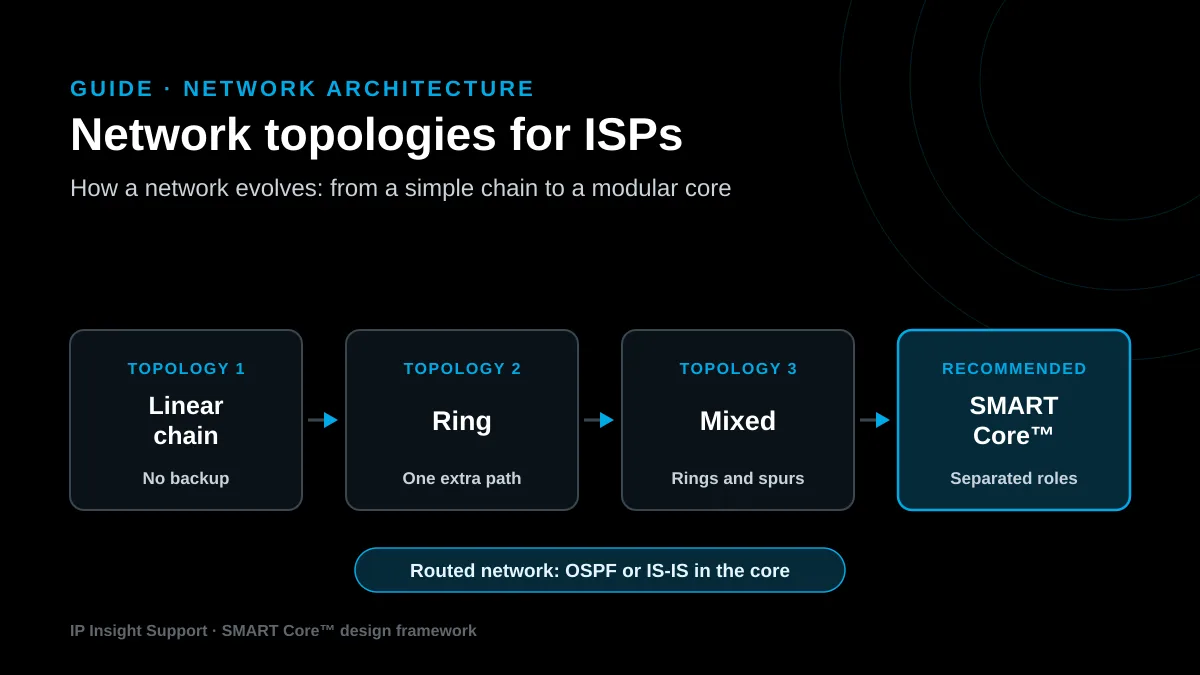
Network Topologies for ISPs: Backbone, Ring and Mixed
How the most common ISP and WISP topologies compare, and how to move past their limits.
Read the guide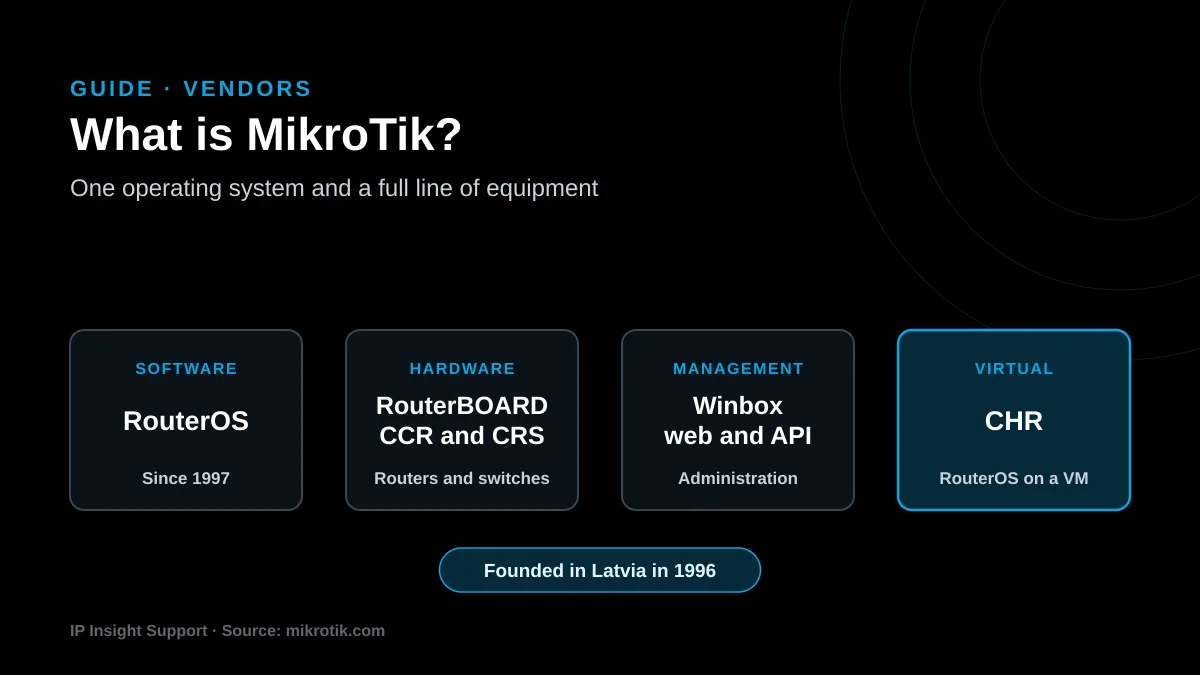
What Is MikroTik? RouterOS and Equipment for ISPs
What MikroTik is and why ISPs, WISPs and businesses use it: routing power, security features and versatility at a cost that scales with the network.
Read the guideFrequently asked questions
Do you have another question? Write to us and an engineer will answer, in English or Spanish.
Why migrate from bridge to OSPF?
In a bridged network all towers share one broadcast domain, and a loop or broadcast storm can affect the whole network. With OSPF each site is its own segment, problems stay isolated and the network uses alternate paths when a link fails.
What is OSPF?
OSPF (Open Shortest Path First) is an interior routing protocol that calculates the best path inside your network and reacts to link failures. The IPv4 version is defined in RFC 2328 and the IPv6 version in RFC 5340.
Will customers lose service during the migration?
We plan it in stages, tower by tower, in agreed maintenance windows. Every change has a rollback plan, and we validate each site before moving to the next.
How long does the migration take?
It depends on the size of the network, the number of sites and the available windows. After the assessment we give you a plan with stages and timelines for your network.
Can I migrate to OSPF with MikroTik equipment?
Yes. It’s one of the migrations we do most often on MikroTik networks, and we also work with other vendors.
What happens to my PPPoE or DHCP subscribers?
We review where each service terminates today and place it in the routed design, so authentication and address assignment keep working.
Ready to leave the bridged network behind?
Let’s talk about your current topology and define a staged migration plan to OSPF.