


IPv6 implementation for ISPs and enterprises
We handle IPv6 implementation on your network: we design the addressing plan and turn it on in the core, edge and access, so subscribers get native IPv6 alongside IPv4 without service impact.
10+ years of experience Multi-vendor compatibility Dual stack Addressing plan
Where this service fits in the life of your network
Each service hands a documented network to the next one, so you can start at the stage your network needs today.
- Know what you haveNetwork audit and documentationExplore
- Build what you needNetwork design and implementationExplore
- Make it performNetwork engineering and architectureExplore
- Move it forwardNetwork migration and IPv6Explore
Run an RV park, campground or hotel? NETXIOM applies the same lifecycle to managed guest WiFi.
Native IPv6, not a patch
We start from an IPv6 addressing plan built for your network and its growth. Then we enable it in the core, edge and access, with the security policies IPv6 needs.
We work with equipment from many vendors and take care of coexistence with IPv4 and CGNAT throughout the rollout. When we finish, your addressing plan and policies are documented.
- IPv6 addressing plan per site and per subscriber
- Dual stack in the core, edge and access
- Announcing your IPv6 prefixes over BGP
- Subscriber delivery with DHCPv6-PD or SLAAC
- IPv6-specific firewall and filters
- Monitoring and rollout documentation
From allocation to subscribers on IPv6
A layered rollout that reduces risk.
Plan
We design the addressing plan from the block assigned by your regional registry.
Enable the core
We enable IPv6 in the core and edge, and announce your prefixes to providers.
Deliver
We enable IPv6 at the access layer, starting with a pilot group of subscribers.
Validate
We measure traffic, review security and document the full rollout.
What implementing IPv6 gives you
Less IPv4 dependence
IPv6 traffic doesn’t go through CGNAT.
Growth without address limits
Plenty of addresses for every subscriber.
Better experience
IPv6-enabled services connect without intermediate translation.
A network that’s ready
Ready for customers and services that already require IPv6.
IPv6 implemented with ISP experience
Implementing IPv6 isn’t just switching it on. Our engineers take care of the addressing plan, security and coexistence with IPv4 and CGNAT, so the rollout is stable from day one.
Every subscriber on IPv6 is one less connection through your CGNAT.
Where your network can go from here

Network migration and IPv6
IPv6, topology changes and new network solutions, executed with minimal risk and downtime.
Explore network migration and IPv6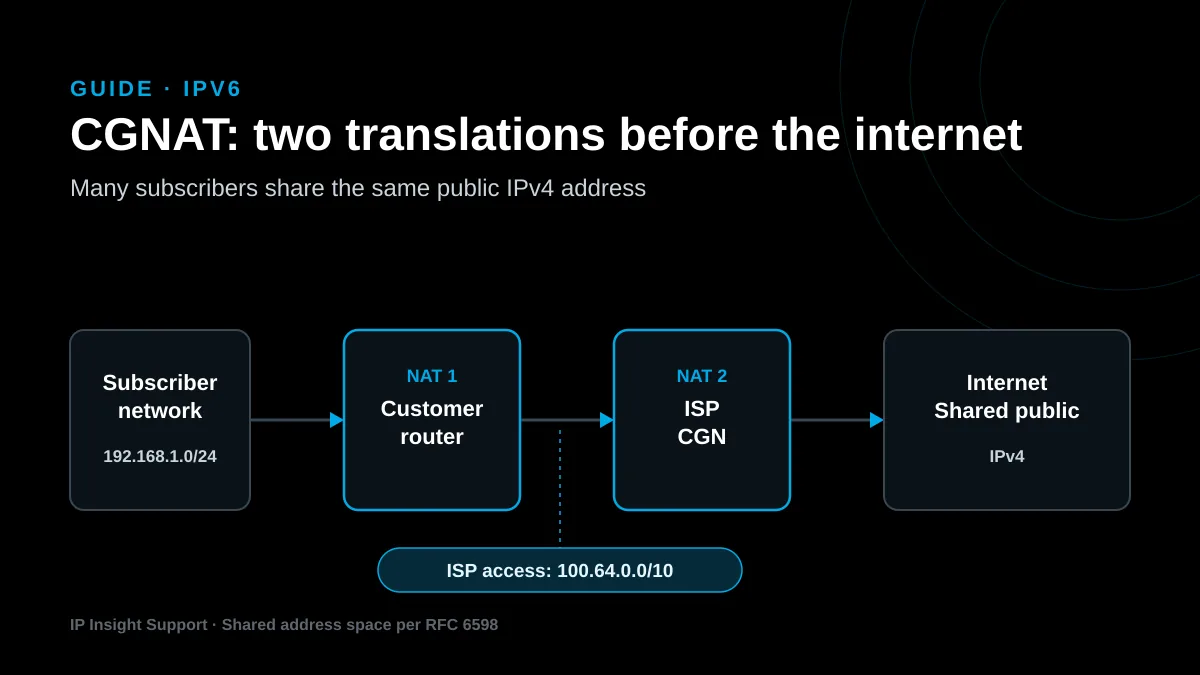
What Is CGNAT and When Does an ISP Need It?
What CGNAT is, how the 100.64.0.0/10 range works, when an ISP without new IPv4 needs it and why IPv6 is the long-term answer.
Read the guide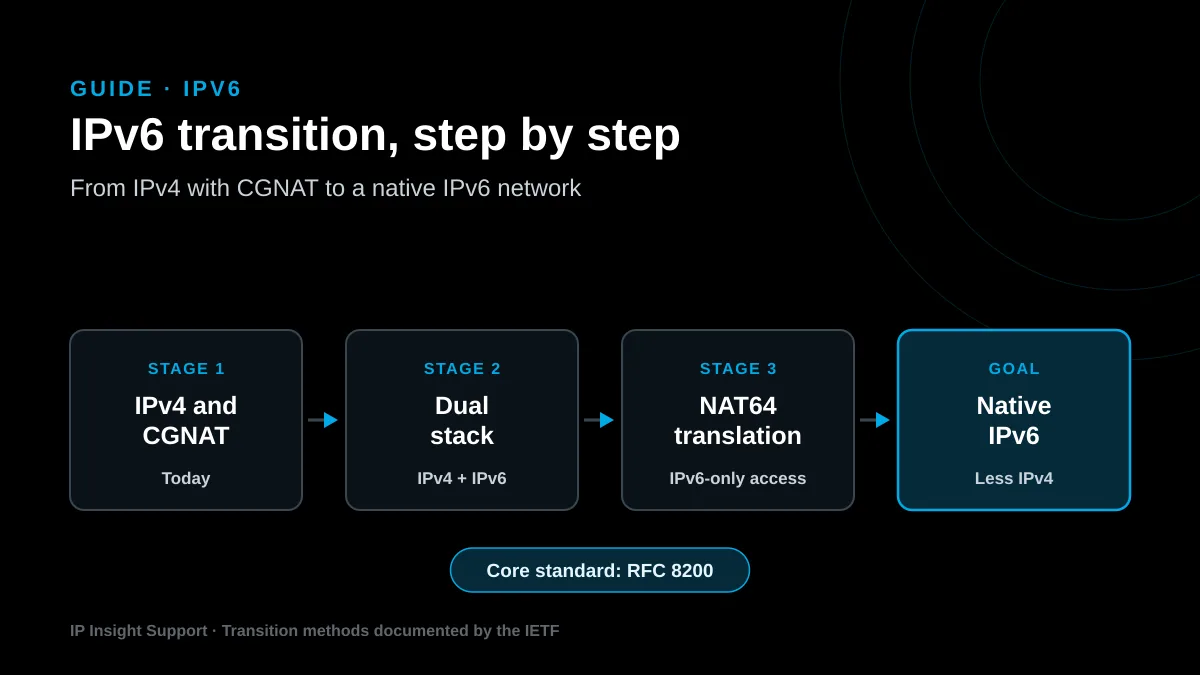
IPv6 Transition: A Guide for ISPs and Businesses
Key advantages, common mistakes and the methodology we use to migrate safely.
Read the guideFrequently asked questions
Do you have another question? Write to us and an engineer will answer, in English or Spanish.
What’s the difference between implementing and migrating to IPv6?
Implementing IPv6 means turning it on in your network: addressing plan, core, edge and access. Migration is the full transition, including how IPv6 coexists with IPv4 and CGNAT along the way. This service focuses on the technical implementation; the full transition is covered by our network migration service.
What IPv6 block does an ISP need?
Usually a /32 assigned by your regional registry, such as ARIN or LACNIC, although the size depends on your number of subscribers and sites. We help you justify and plan the block.
What is dual stack?
It means running IPv4 and IPv6 at the same time on the same network. It’s the most common way to introduce IPv6 without affecting services that still only work over IPv4.
How do subscribers receive IPv6?
Depending on the access type, with prefix delegation through DHCPv6-PD, with SLAAC, or both. We define the prefix size for each customer and document it.
Does IPv6 need its own security rules?
Yes. IPv6 has protocols IPv4 doesn’t, such as ICMPv6 and neighbor discovery, and needs specific filters. We design them as part of the rollout.
Does implementing IPv6 remove the need for CGNAT?
Not right away. As long as IPv4-only services exist, you’ll still need IPv4 or CGNAT. But every service used over IPv6 reduces the load on your CGNAT.
Ready to deliver IPv6 to your subscribers?
Let’s talk about your block, your network and your subscribers, and define a layered implementation plan.