What Is Network Infrastructure? Components and Types
What is network infrastructure? It’s the set of hardware, cabling, links and software that lets users, servers and services talk to each other. It includes routers, switches, access points, firewalls, fiber or copper and the tools that manage them. As a result, in an ISP or a business, its design sets the speed, the stability and the room to grow.
In short
| Topic | In a few words |
|---|---|
| What it is | In short, the devices, links and software that connect an organization. |
| Components | Mainly routers, switches, firewalls, APs, cabling and management. |
| Types | For example, local, campus, provider, data center and virtual. |
| Cabling standard | ISO/IEC 11801 for structured cabling. |
| Design | Above all, in layers: core, distribution and access. |
| Documentation | Also inventory, diagrams, addressing and configurations. |
What are the components of network infrastructure?
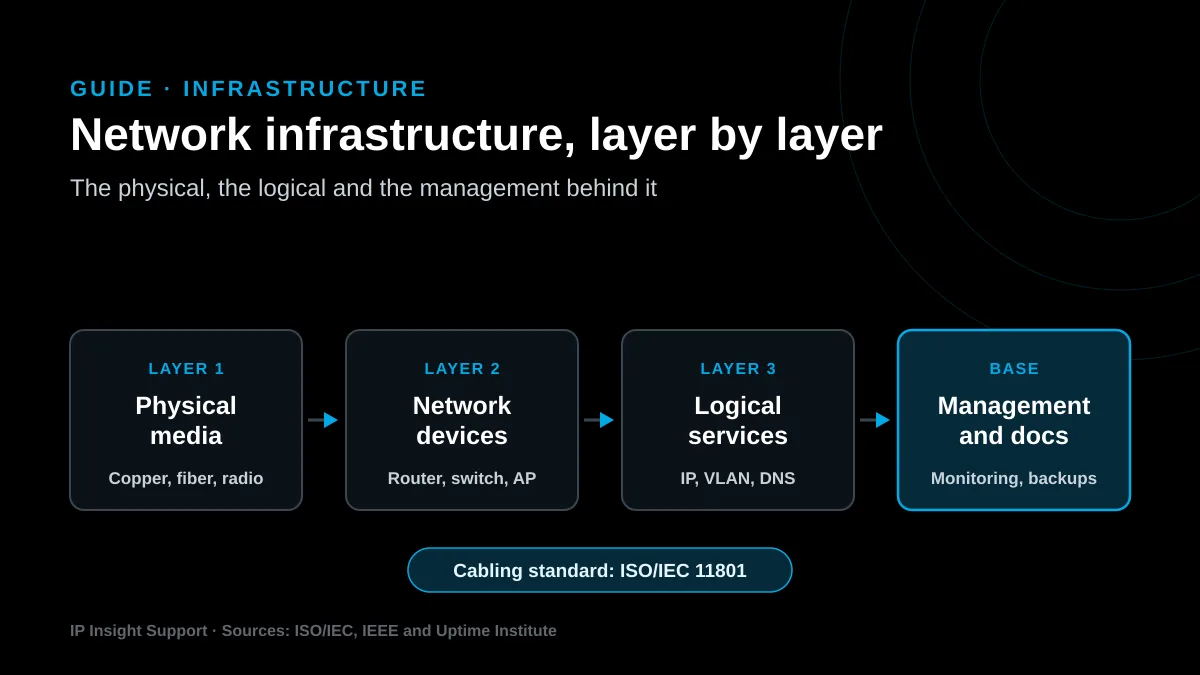
Every network infrastructure has a physical side and a logical side. In addition, both need to be documented, because a failure in either one stops the service.
- Routers: connect different networks and choose the path for traffic, including the way out to the internet.
- Switches: join devices inside the local network and, in addition, separate traffic by VLAN.
- Firewalls: filter what comes in and goes out; that way they enforce security policies.
- Access points and radio links: carry connectivity without cables, for example to users, sites or towers.
- Physical media: copper, fiber optics and also wireless links.
- Services and management: DNS, DHCP, RADIUS, monitoring, backups and logs.
Cabling, in turn, has its own standards. The ISO/IEC 11801 series defines generic structured cabling, and its part 1, published in 2017, sets the requirements shared by the whole series. Meanwhile, Ethernet is defined in IEEE 802.3, which today covers speeds from 1 Mb/s to 400 Gb/s.
What types of network infrastructure are there?
You can classify them by reach and by how they’re built.
- Local area network (LAN): for example, an office, a building or a hotel.
- Campus network: that is, several connected buildings, such as a plant or a park.
- Provider network: the core, distribution and access of an ISP or a WISP.
- Data center network: high-density switches, redundant links and connections to several carriers.
- Virtual infrastructure: routers, firewalls and switches that run as software on servers or in the cloud.
In practice, one organization often combines several types. For instance, an ISP runs its provider network and, at the same time, a local network in its offices. See also the most common network topologies for ISPs.
How do you design network infrastructure?
Design starts from the services the network must support, not from the hardware. First, define the users, the sites, the expected traffic and the availability target. Then choose the architecture.
- Requirements: sites, users, applications, growth and budget.
- Layered architecture: core, distribution and access, each with its own job.
- Redundancy: duplicate links and devices wherever an outage is costly, such as the main uplink.
- Addressing: an IPv4 and IPv6 plan, VLANs and routing.
- Security: segmentation, firewalls and access control from the start, not at the end.
- Rollout and testing: deploy in stages and, after that, validate before going live.
If you need support at this stage, take a look at our network design and implementation service.
What should network documentation include?
A network infrastructure without documentation depends on one person’s memory. Therefore, the minimum documentation should include:
- First, an inventory of devices with model, location and role.
- Next, up-to-date physical and logical diagrams.
- Also, the IP addressing and VLAN plan.
- In addition, a backup of every device’s configuration.
- Contracts and contacts for transit and support providers.
- Finally, procedures for changes and for handling outages.
What are the most common failures?
Network failures have a real cost. According to the Uptime Institute Annual Outage Analysis 2025, 54% of respondents said their most recent significant outage cost more than 100,000 USD. Moreover, outages caused by IT and network issues are on the rise.
- A single point of failure in the internet link or the main router.
- Changes made without a procedure or a rollback plan.
- Devices left without updates and, on top of that, without monitoring.
- Flat, unsegmented networks, where one problem spreads everywhere.
- Missing documentation, which makes every diagnosis take longer.
That’s why a network monitoring platform pays off: it warns you before users notice.
When should you audit your network infrastructure?
- Before growing or migrating, so you know what the current network can handle.
- After repeated outages without a clear cause.
- Also when the technical team changes and documentation is missing.
- Before buying hardware; that way you don’t invest in the wrong place.
How do we handle it at IP Insight Support?
Our engineers audit the existing network, build the inventory and the diagrams, and deliver a report with findings and priorities. After that, we design and implement the improvements without stopping operations, and we hand over a fully documented network. Learn more about our network audit and documentation service.
Network infrastructure frequently asked questions
What’s the difference between network infrastructure and topology?
Topology describes how the nodes connect, for example in a ring or a star. Infrastructure, on the other hand, includes everything that makes that network work: devices, cabling, links and management.
Does network infrastructure include servers?
Servers are usually considered part of the IT infrastructure, not the network. However, the services that keep the network running, such as DNS, DHCP or RADIUS, are part of it.
How often should the network be reviewed?
A good rule is at least once a year, and also before any growth or migration. Between reviews, continuous monitoring catches problems in time.
What is virtual network infrastructure?
It’s infrastructure that uses routers, switches or firewalls running as software, on your own servers or in the cloud. Even so, it lives alongside the physical side, which is still needed to connect users and sites.
How much does network infrastructure cost?
It depends on the size, the redundancy and the hardware you choose. For that reason, a design done upfront lets you estimate the real cost and avoids buying too much or too little.
Can it be improved without downtime?
Yes, if it’s planned in stages. Each change is tested in a maintenance window and always with a rollback plan.
Want to review or improve the network infrastructure of your business or ISP? Talk to an engineer and let’s look at your case.
More guides for network operators
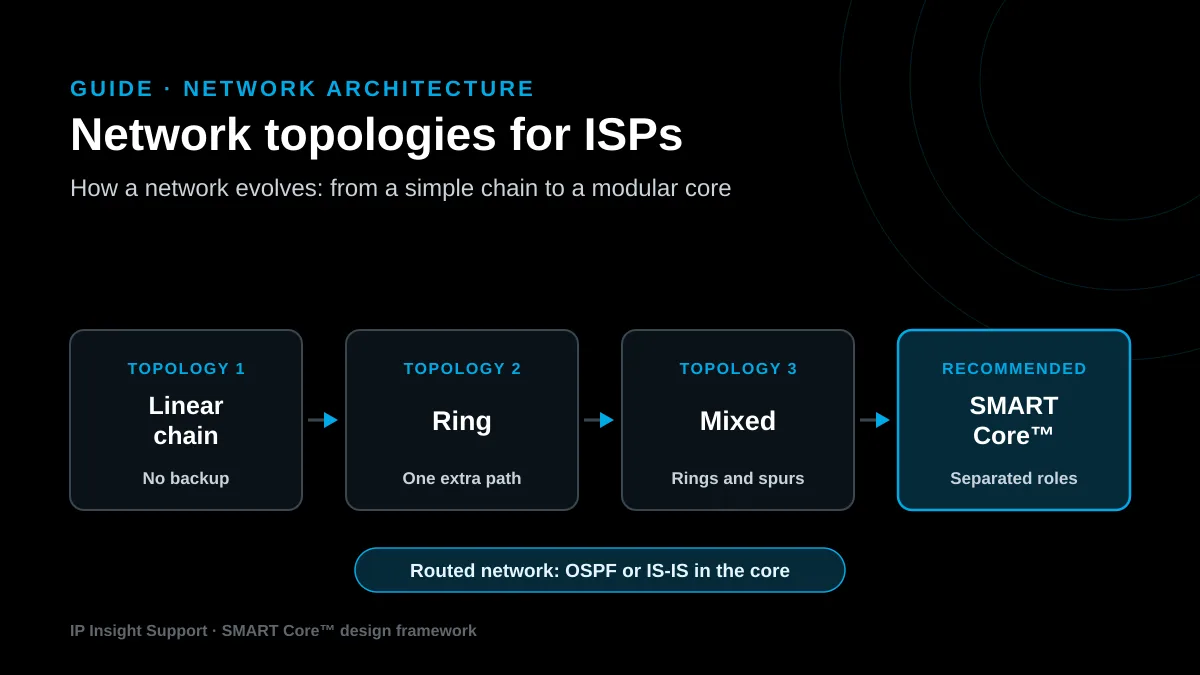
Network Topologies for ISPs: Backbone, Ring and Mixed
Read the guide